VPS Cloud Platform

On this page we give a small insight into how our cloud platform for VPS works. The main advantage of a cloud VPS is that it is not tied to a single machine or location. With the cloud solution, your VPS can run on a different node at any time. This allows us to guarantee higher uptime and enables you to access your VPS from anywhere in the world.

The platform consists of 3 components:
- Storage (data storage)
- Nodes (servers that run the VPSs)
- Backup (optional)

Storage

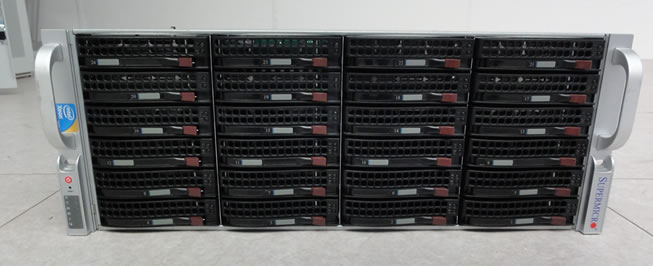
Storage is required to securely and quickly store all VPS data. Anyone who thinks all data is stored on a single machine is mistaken. We used to work that way in the past, but that single storage server has since been replaced by a full cluster of storage nodes. We also distinguish between HDD storage nodes and SSD storage nodes.

NVME Node Specifications

3x Supermicro servers, with:
AMD EPYC 9135 (16 cores total)
256 GB ECC REG RAM
6x 8 TB Samsung SOLIDIGM NVME SSD datacenter grade
2x 512GB SOLIDIGM SSD (boot disks)
2x 100 Gbit/sec network

This provides a total of 144TB SSD storage. The nodes have 12 SSD slots per server, leaving plenty of room for future expansion.

SSD Node Specifications

8x Supermicro servers, with:
2x Intel Xeon E5-2660 V3 2.6GHz (20 cores total)
128 GB ECC REG RAM
16x 4 TB Samsung PM883 SSD
1x 120GB Intel SSD (boot disk)
4x 10 Gbit/sec network

This provides a total of 512TB SSD storage. The nodes have 24 SSD slots per server, leaving plenty of room for future expansion.

HDD Node Specifications

7x Supermicro servers, with:
2x Intel Xeon E5-2660 3.0GHz (8 cores total)
64 GB DDR3 ECC REG RAM
12x 4 or 6 TB Toshiba HDD
2x 240GB Samsung SM843 SSD (for caching)
1x 120GB Intel SSD (boot disk)
4x 10 Gbit/sec network

Total is a little over half a petabyte of storage.
This number can easily be expanded by simply adding another node to the cluster.

Network Infrastructure

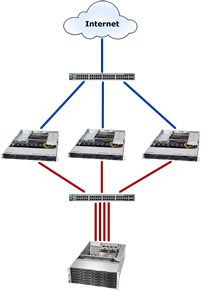
A good VPS platform also requires a strong underlying network infrastructure. Not only internet traffic runs through it, but also storage traffic. That is why stability and speed are essential. We therefore use Arista switches, which are ultra low-latency and ideal for this environment. The network infrastructure is fully redundant so that a switch failure does not bring VPS environments down. For security reasons, the data network and internet network are separated, as shown in the diagram below.


We have multiple 10 Gbit/sec and 100 Gbit/sec connections between nodes and storage servers. This ensures there are no performance bottlenecks in the network. The uplinks are 4x100 Gbit/sec, providing a total of 400 Gbit/sec connectivity between locations and the VPS cluster.

Software & Redundancy

We use a storage system called Ceph. Ceph ensures that all data is stored at least 3 times across different hard drives and servers. This allows up to 2 nodes to fail without interruption. Ceph can be compared to traditional RAID, but at server level.

Dual Power Supply

The servers have dual power supplies to prevent data loss due to power failure. Both power supplies are connected to separate power feeds.

Monitoring

To support Ceph, we also use monitoring nodes. We have 3 of these deployed redundantly. These are relatively simple machines (Quad-core, 8GB RAM, 120GB SSD, 2x 10 Gbit/sec network) that monitor the storage cluster and help distribute data across the storage nodes.

Backup

VPS backup storage can optionally be purchased. This ensures your data is backed up every night to one of our backup servers. These backup servers are geographically separated and connected via a redundant 25 Gbit/sec link.

Packages & Pricing

Click here to go to the packages and pricing page.

Hypervisor

Our cloud VPS cluster uses the KVM hypervisor.

Nodes

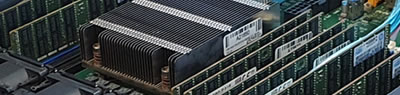
Above the storage cluster sit the server nodes. Their job is to perform the actual virtualization. The nodes need to be very powerful, since each node runs on average around 30 VPS instances. Therefore, each node has at least two twenty-core processors and a minimum of 512GB RAM. Currently we have 15 nodes running with the following specifications:

Server 110

- Dual AMD EPYC 9354
- 64 x 3.80 GHz HT
- 1536 GB DDR5 ECC REG RAM


Server 112

- Dual AMD EPYC 9354
- 64 x 3.80 GHz HT
- 1536 GB DDR5 ECC REG RAM


Server 113

- Dual AMD EPYC 9354
- 64 x 3.80 GHz HT
- 1536 GB DDR5 ECC REG RAM


Server 114

- Dual AMD EPYC 9354
- 64 x 3.80 GHz HT
- 1536 GB DDR5 ECC REG RAM


Server 115

- Dual AMD EPYC 9354
- 64 x 3.80 GHz HT
- 1536 GB DDR5 ECC REG RAM


Server 116

- Dual AMD EPYC 9354
- 64 x 3.80 GHz HT
- 1536 GB DDR5 ECC REG RAM


Server 117

- Dual AMD EPYC 9354
- 64 x 3.80 GHz HT
- 1536 GB DDR5 ECC REG RAM


Server 119

- Dual AMD EPYC 7642
- 96 x 3.40 GHz HT
- 1024 GB DDR5 ECC REG RAM


Server 91

- Dual Xeon Gold 6138
- 40 x 2.00 GHz HT
- 512 GB DDR4 ECC REG RAM


Server 92

- Dual Xeon Gold 6138
- 40 x 2.00 GHz HT
- 512 GB DDR4 ECC REG RAM


Server 93

- Dual Xeon Gold 6138
- 40 x 2.00 GHz HT
- 512 GB DDR4 ECC REG RAM

The nodes are connected to both the internet and the storage platform. Because all nodes have access to the same storage data, we can easily move a VPS from one physical node to another. This is useful in case of issues or maintenance on a specific node. This migration can even be done without interrupting the VPS. Users will not notice any downtime, allowing us to offer true high availability.