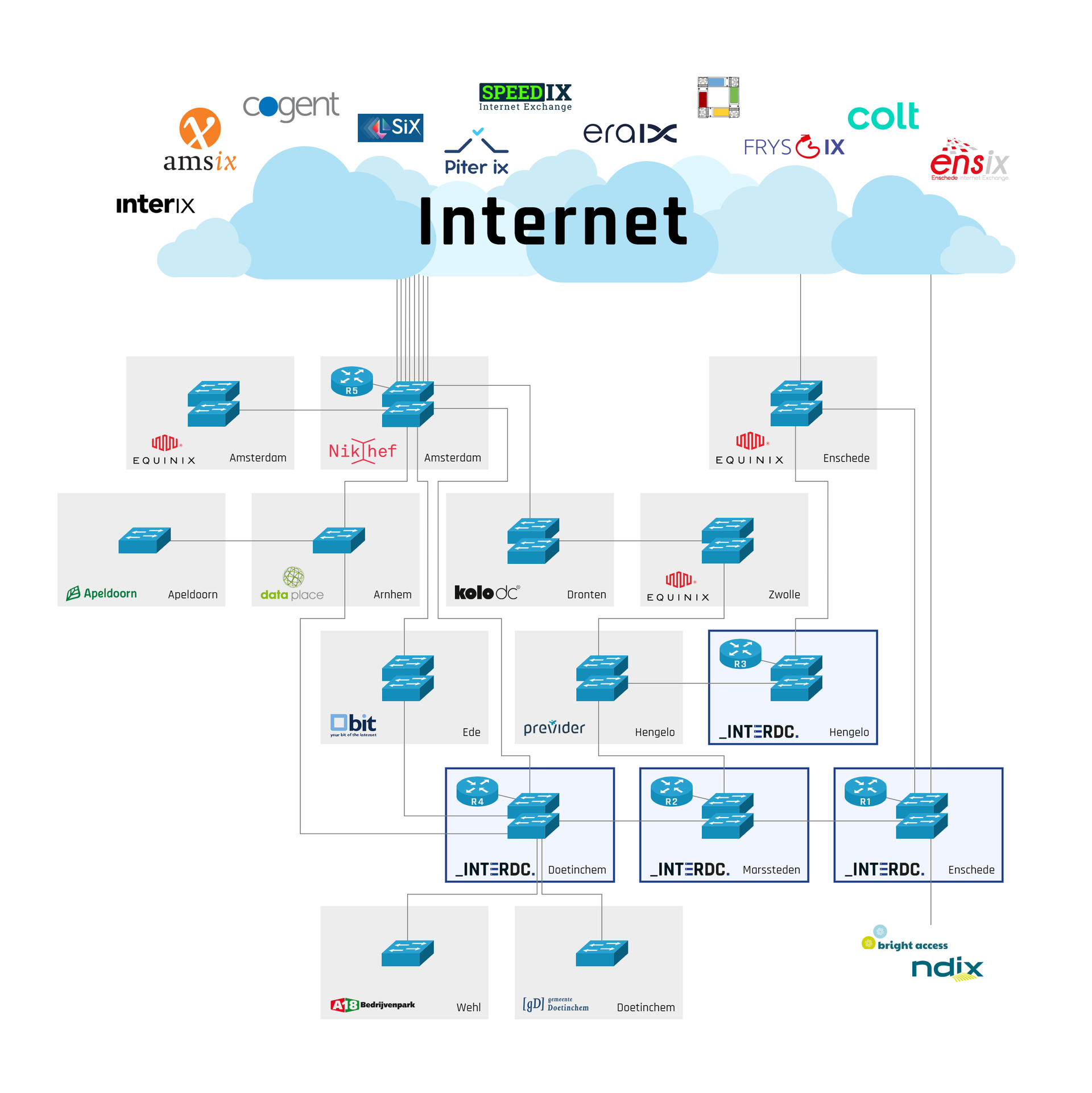
Internet uplinks

Our network spans 12 datacenters: Dataplace Arnhem, Equinix Enschede, InterDC Enschede 1 & 2, InterDC Hengelo, InterDC Doetinchem, Nikhef Amsterdam, Equinix Amsterdam, Equinix Zwolle, KoloDC Dronten, Bit2 Ede and Previder Hengelo. We have 12 different uplinks. Between all datacenters we operate our own redundant fiber connections.

Total uplinks include:

  • AMS-IX
  • ENS-IX
  • Speed-IX
  • LS-IX
  • Frys-IX
  • ERA-IX
  • INTER-IX
  • PITER-IX
  • Cogent
  • Lumen
  • ND-IX
  • Bright Access

Total uplinks provide an internet capacity of 300,000 Mbit/s.

Schematic overview

Our network looks schematically as follows:

More information about our network can be found on:

AS42093.net

We operate the following prefixes:

AS
42093

IPv4
- 195.22.100.0/22
- 178.251.24.0/21
- 185.10.156.0/22

IPv6
- 2a00:1938::/32

Redundancy

Our network is configured in such a way that if a router or switch fails, no outage occurs. The failed device is automatically taken over within a fraction of a second. This also applies to our internet uplinks. If one link goes down, traffic is instantly rerouted and the load is distributed across the remaining links. Because of this highly stable and fail-safe design, we have achieved impressive uptimes:

Uptime 2007: 99.996%
Uptime 2008: 100%
Uptime 2009: 100%
Uptime 2010: 100%
Uptime 2011: 100%
Uptime 2012: 100%
Uptime 2013: 100%
Uptime 2014: 100%
Uptime 2015: 100%
Uptime 2016: 100%
Uptime 2017: 100%
Uptime 2018: 100%
Uptime 2019: 100%
Uptime 2020: 100%
Uptime 2021: 100%
Uptime 2022: 100%
Uptime 2023: 100%
Uptime 2024: 100%
Uptime 2025: 100%

Internet Exchanges

Several of our uplinks connect to Internet Exchanges. An Internet Exchange is a hub where internet providers and companies meet to exchange traffic. The major advantage is that it provides direct connections with other internet companies and parties such as NPO, Steam, Apple, Google, and Netflix. This results in extremely low latency and high available capacity.

Name

AS

Status

AMS-IX

6777

Online

ERA-IX

206221

Online

Frys-IX

56393

Online

Inter-IX

56584

Online

NDIX

20828

Online

LSIX

49917

Online

SpeedIX

41441

Online

ENS-IX

215549

Online

FOGIXP

61190

Online

Piter-IX

48193

Online
The complete list can be found at:
www.as42093.net/peers.php

IPv6 Ready
In 2010 we started making our network IPv6 ready, and since May 2011 our network is fully IPv6 ready. The IPv6 implementation runs completely native alongside IPv4.


RIPE
IceHosting is a RIPE member

Ping times

Ping indicates how much time a server or computer needs to send a message to another endpoint. Because these speeds are extremely fast, the time is measured in milliseconds (ms). One second equals 1000 ms.

We have an average ping of 1 to 2 ms to other Dutch providers. In addition, we have a direct connection to Düsseldorf, giving us low latency to German parties as well.

You can view live ping times here:
smokeping.icehosting.nl

Hardware

For our network we use 3 hardware vendors:
Arista - for routers and core switches
Arista & Huawei - for edge switches
Ruckus - for management switches

Our network consists of 4 layers:
- Routers
- Core switching
- Edge switching (10 and 1Gb)
- Management switching

Routers
For routing we use Arista 7280 series routers, minimally equipped with 32GB RAM. The routers are redundantly configured using the VRRP protocol and route traffic based on BGP information.

Core
Our core switching consists of Arista 7060 series switches. Each switch provides 32x 100Gb/s fiber ports. With at least 4 ports we interconnect the different datacenters, providing at least 400Gb/s capacity.

Edge
The first edge switches are Arista 7050 series switches, offering 48x 10Gb/s fiber ports. Ideal for high-capacity servers. These are connected to the core with 40Gb/s or 100Gb/s uplinks.
The second edge switches are Huawei 5720 series switches. These provide 4x 10Gb/s uplinks to two different core or edge switches and deliver 1Gb/s UTP connectivity to servers.

Management
The management network is a separate network between all servers and IPMI. By separating it from the main network, we can also use it as a backup network, ensuring we always have access to all devices. Since this network does not require a high management overhead, we use the Ruckus ICX series.